From the Wall to the Screen
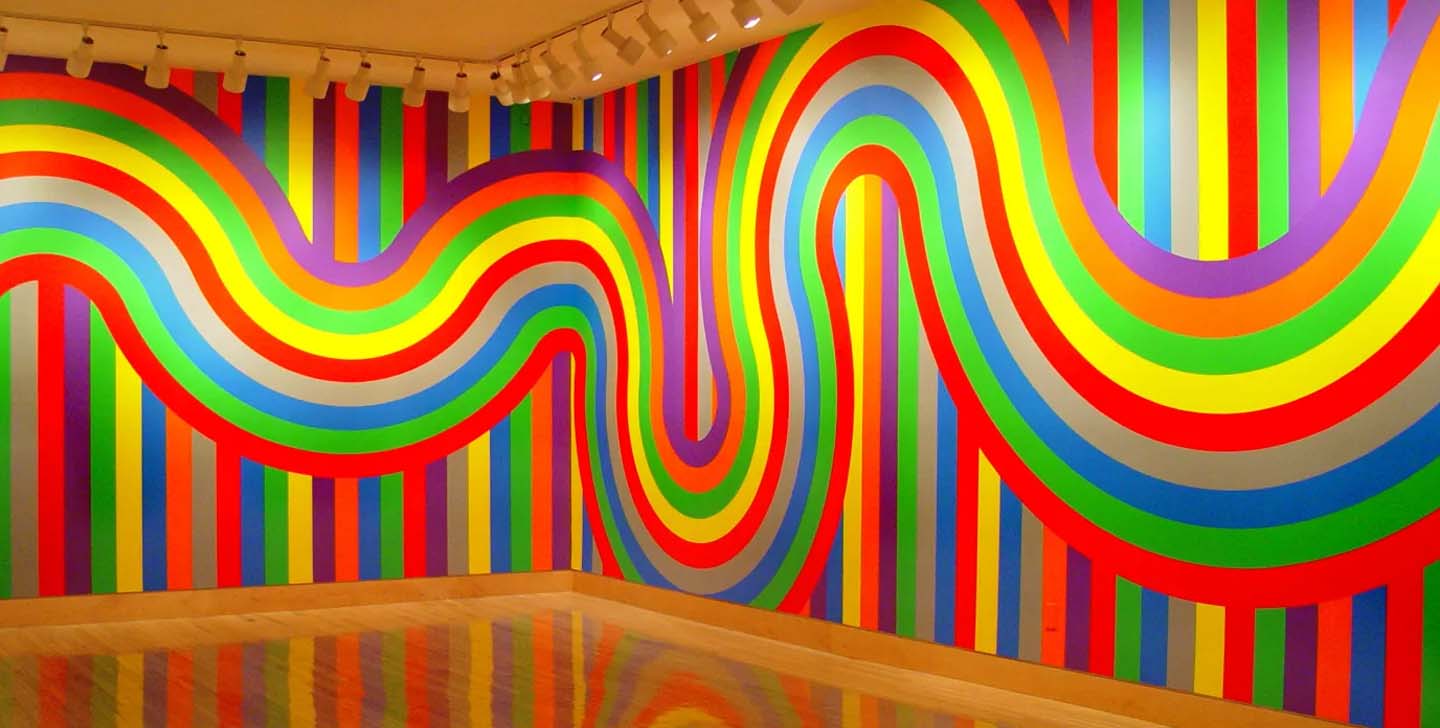
Although personal computers and modern programming languages did not yet exist, Sol LeWitt’s working method relied on the same algorithmic logic that underpins computer programs: defining a sequence of steps to achieve an expected outcome.
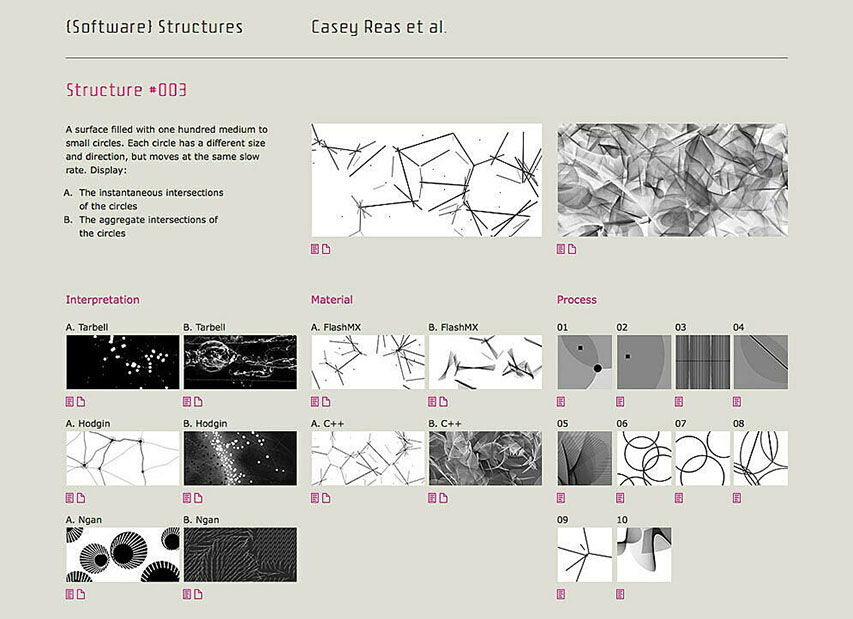
This connection between conceptual art and programming became the starting point for one of the projects of American artist and educator Casey Reas. In 2004, Reas took three of LeWitt’s wall drawing instructions and wrote several computer programs based on them. The result was {Software} Structures, a series of twenty-six code-based artworks that are now part of the collection of the Whitney Museum of American Art.
Reas’s project was not simply a translation of LeWitt’s work onto a screen. It also demonstrated how code can generate complex and compelling visual behaviours when the right programming languages are used.
Processing and p5.js
More than for his work as an artist, Casey Reas is known for co-creating, alongside Ben Fry, the programming language Processing. It was developed with the goal of encouraging the use of code in the visual arts while also bringing visual culture into the realm of software.
Although other languages linked to computational art already existed, what set Processing apart was its accessibility. Compared with more technical and difficult environments, Processing offered an experience closer to a digital sketchbook, where writing code and seeing the results on screen happen almost simultaneously. This simplicity became even more evident when Processing, originally based on Java, evolved into p5.js, a JavaScript adaptation designed to run directly in any web browser.
Yet the value of Processing and p5.js lies not only in their ability to create images. Their significance also comes from teaching a different way of thinking visually: working with systems, rules, iteration, and chance. They do not merely create forms; they allow creators to design processes and generate multiple outcomes along the way, not just at the end.

AI, Prompts, and Creative Computing
One of the main differences between human languages and programming languages is that the former are inherently ambiguous, while the latter operate through strict syntactic rules. A text written in natural language can be interpreted in different ways; code, by contrast, demands absolute precision. A single misplaced word can cause an entire system to fail.
Although that distinction still exists, the emergence of generative AI is transforming our relationship with software. After all, what is a prompt if not a written instruction designed to produce a result? In a sense, these tools revisit some of the questions that artists such as Sol LeWitt were already raising decades ago: to what extent does creating consist of defining processes and rules rather than producing images directly?
There is, however, a fundamental difference between writing code and working with generative models. Processing, like any programming language, executes exact and predictable instructions. Large language models, by contrast, infer intentions from natural language, even when prompts are ambiguous or incomplete. Code seeks precision; AI prioritizes interpretation.
That does not mean one tool must be chosen over the other. In fact, it is increasingly common for both to coexist within the same creative process. Generative models can actually write code, but creative computing environments provide a level of control that is difficult to achieve through prompts alone.
Perhaps the most important question, however, is not technological but cultural. In a world where generating images is becoming ever easier, understanding the systems that produce them may become a form of creative literacy. Learning Processing or p5.js is no longer simply about writing lines of code. It is also about understanding how rules, data, and chance can be transformed into visual experiences. Creative coding is not merely the acquisition of technical skills. It is a way of understanding, questioning, and reshaping the technologies through which we design the present.