Colour Associations and Emotions
As Seurat, one of the founders of Neo-Impressionism, once put it:
“Joy as a feeling has always been associated with luminosity as the dominant tone, warmth as the dominant hue, and upward-leaning lines as the dominant direction. Calmness, on the other hand, relies on an equilibrium between darkness and light in tone, between warm and cool in hue, and horizontal lines as the dominant direction. Sadness is expressed through darkness, cool tones, and descending lines.”
This passage completely hooked me. It was the spark that got me fascinated by this kind of sensitivity and perception, especially when it comes to colour.
A Brief History of Colour and Its Uses
The historical journey of colour is truly fascinating. Before the medieval period, early perceptions of colour were tied to the four elements: earth, air, fire, and water. There was no unified understanding of what colours actually were. Medieval art was driven far more by expression than by realistic form.
Medieval stained-glass windows, where they’ve survived, used colour for symbolic and decorative purposes. In the earliest German examples, such as those in Augsburg (southern Germany, near Munich), white backgrounds dominated, paired with strong red-green contrasts.
A bit later, following the Cathedral of Chartres (12th century), often called the temple of light, though located in Saint-Denis near Paris, blue became the dominant background colour for scenes. Blue was conceptually seen as the darkest colour, alongside black.
Early French stained-glass was designed to create an impenetrable darkness that somehow carried light, an analogy to the unknowable God of early medieval theology. The idea of luminous yet impenetrable darkness is a captivating concept that defined much of the medieval era.
By the late 16th century, Aristotle remained the main authority on natural philosophy. The peripatetic philosopher had identified three colours in the rainbow: red, yellow/green, and purple. By the 17th century, red-yellow-blue had become established across Europe as the fundamental colours among artists. The three primaries: two warm (red and yellow) and one cool (blue).
Colour in Art
Following this quick historical sweep, we can see that the use of colour in art has undergone a significant evolution, both in technique and in intention.
The brothers Hubert and Jan van Eyck began building compositional patterns around local colours of people or objects. Local colours refer to muted and bright, light and dark tones that create a realistic image, staying very close to how things appear in nature.

Piero della Francesca (1410–1492) painted with sharp contours and clearly expressive zones, using balanced complementary colours.
Leonardo da Vinci (1452–1519) rejected strong, flat colouring. He worked in infinitesimal tonal gradations, as seen in his Adoration of the Magi or the underpainting for Saint Jerome. Sepia-like tones for light and shadow.

Titian (1477–1576) used isolated zones of homogeneous contrasting colours. Later, he gradually resolved those zones into cool/warm, light/dark distinctions.
El Greco (1541–1614), a pupil of Titian, was only fully appreciated in the 20th century for his true genius. He used primary colour schemes to depict the celestial.
As he put it:
“Primary colours cannot be mixed with any other pair of colours.”
He described primary pigments as something only God could create.

Rembrandt (1606–1669), the quintessential master of chiaroscuro after the era of Leonardo, Titian, and El Greco, used chiaroscuro as a powerful means of expression. He had a different take on it, seeing colour as a dense material with transparent grays and blues or yellows and reds, creating profound depth.
All of this gave way to Romanticism. John Constable (1776–1837) didn’t slap a uniform green onto the canvas; instead, he built it through meticulous gradations of light/dark, cool/warm, muted/vivid tones. J.M.W. Turner (1775–1851) created non-objective colour compositions that arguably place him among the earliest “abstractionists”.
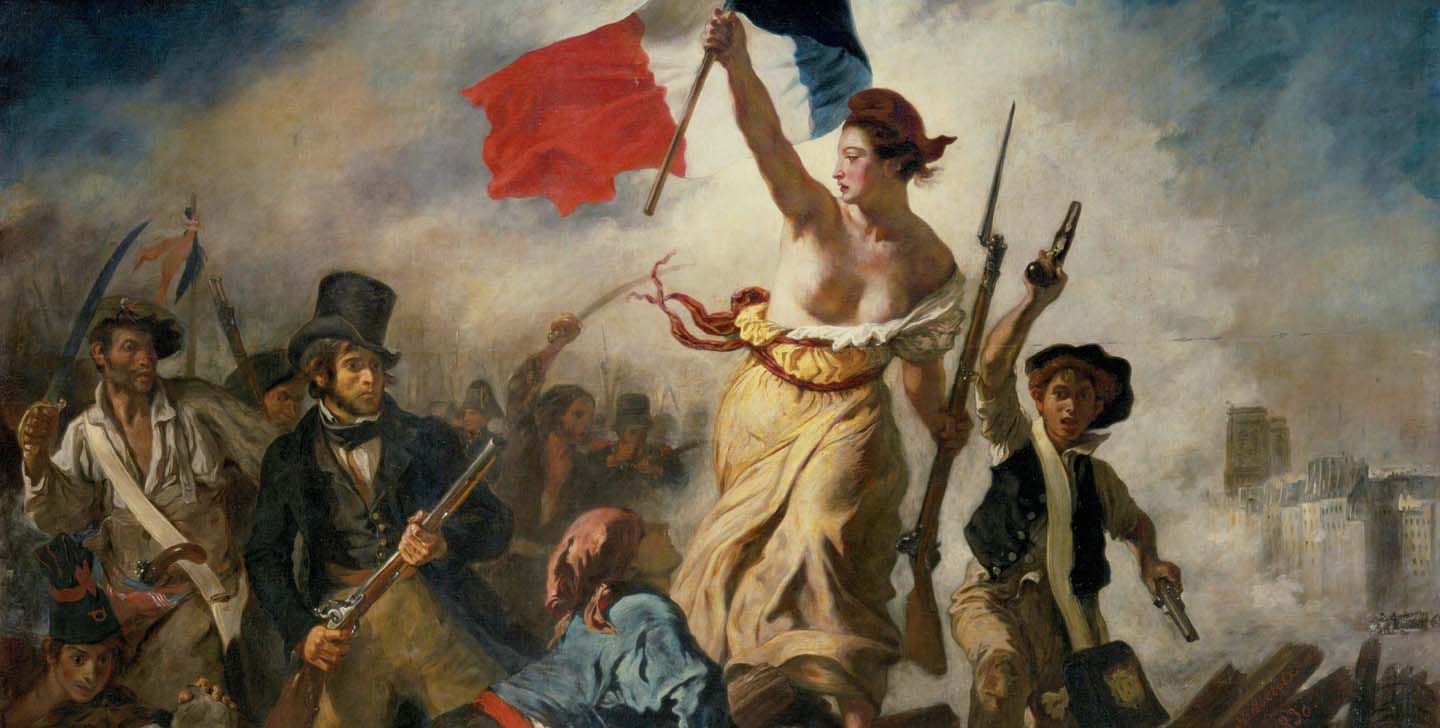
Eugène Delacroix (1798–1863) spent his entire life seriously grappling with the problems and principles of colour.

From Art to Color Theory
In 1810, Philipp Otto Runge published his colour theory, using the sphere as a coordinate system. That same year, Goethe released his major work, Theory of Colours. Schopenhauer followed with “On Vision and Colours” in 1816.
Chemist M.E. Chevreul (1786–1889) published “The Principles of Harmony and Contrast of Colors, and Their Applications to the Arts”. His work became the scientific foundation for Impressionist and Neo-Impressionist painting.
The Impressionists broke colour areas into separate paint elements, insisting that mixing pigments destroys the power of colour. Pure colour points should only mix in the viewer’s eye.
Paul Cézanne (1839–1906) logically developed colour construction. Beyond his rhythmic and formal contributions, he rejected pointillist optical mixing in favour of modulation, the variation between cool/warm, light/dark, muted/intense.

Picasso, Braque, and Gris used colour primarily for its chiaroscuro value. Their main interest was form. They analysed objects by breaking them into abstract geometric shapes.
Colour Takes Centre Stage
It was in the 20th century that sensitivity to colour —and even giving it form—, really took off. There was growing concern with the relationship between colour and form. For Kandinsky, this relationship was central to painting. The Bauhaus famously assigned primary colours to geometric shapes. Kandinsky linked colours to their primary forms:
- Blue — the deepest, most restful roundness, paired with the circle.
- Yellow — psychologically expansive and moving outward.
- Red — the most important colour, assertive, with a forceful nature and internal tension.
Most people surveyed agreed with Kandinsky’s reasoning. But there were dissenters, like Oskar Schlemmer:
“Red, not blue, belongs to the circle, since in nature (sun, fruit) it is an active colour; blue suits the abstract, metaphysical square, a form that doesn’t exist in nature at all.”
Spanish painter Juan Gris (1887–1927), in a 1924 lecture in Paris, spoke about the primary formal polarity between circle and triangle. For Gris, the circle was the most expansive form and therefore suited the brightest palette tones, while the triangle was the most concentrated and therefore appropriate for the darkest. Clearly, a shorthand version of the opposite formula to Kandinsky’s.